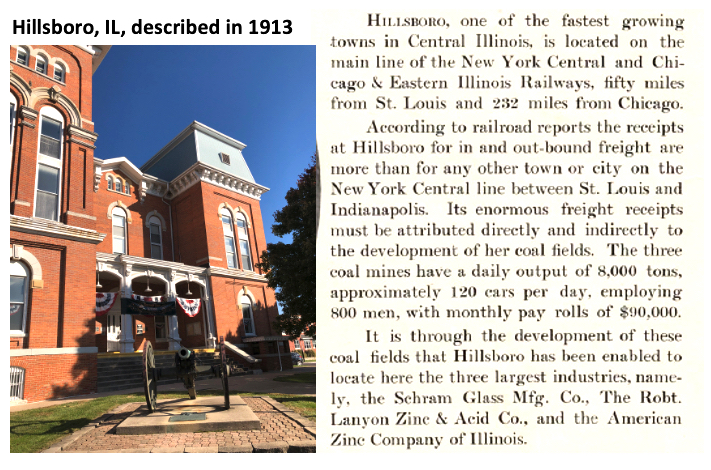

Hillsboro was founded in 1823. Abundant natural resources shaped its economic landscape. The greatest of these natural resources was an eight-foot vein of coal underlying the town. Coal from Hillsboro and nearby smaller towns was primarily used locally rather than shipped out as was the case elsewhere in Illinois coal towns. Two of the world’s largest zinc oxide manufacturing plants were located in Hillsboro and were fueled by its coal.
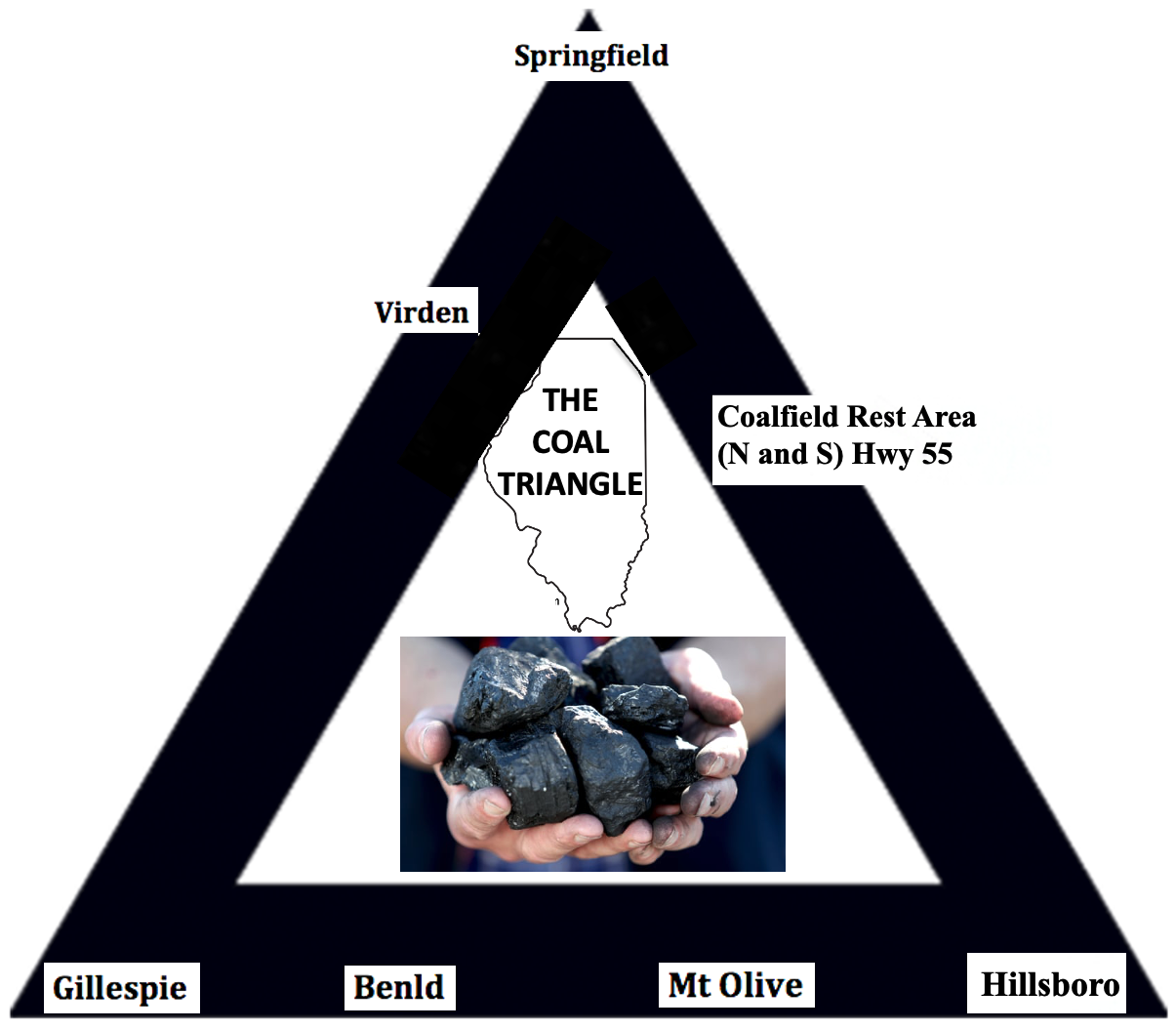
Hillsboro is located in Montgomery County, adjacent to Macoupin County where the “Coal Triangle” is based. We include it in the Coal Triangle tourism route.
In addition to its coal mining and related zinc oxide industry, an important glass factory was created in nearby Schram City, which produced jars and bottles. The use of coal in zinc oxide manufacturing and the diversification of manufacturing in Hillsboro provided a wide range of employment opportunities. This seems to have insulated Hillsboro from the labor unrest that afflicted other coal towns in the central Illinois region.
Hillsboro thrived. An Illinois traction system electric railway provided transportation from Hillsboro to St. Louis, Peoria, Champaign, and dozens of towns in between. Its residents fostered local arts, cultivated a vibrant cultural scene, and invested heavily in education and public services such as parks and a superb library. Hillsboro abounded in fine homes, impressive civic buildings, and a notable opera house. These buildings are visible today.
Hillsboro’s annual Old Settlers’ Days celebration is evidence of the town’s enthusiastic embrace of old and new. Hillsboro is committed to preserving its roots, maintaining its strong community values, and deploying its industrious spirit and local heritage for modern progress.

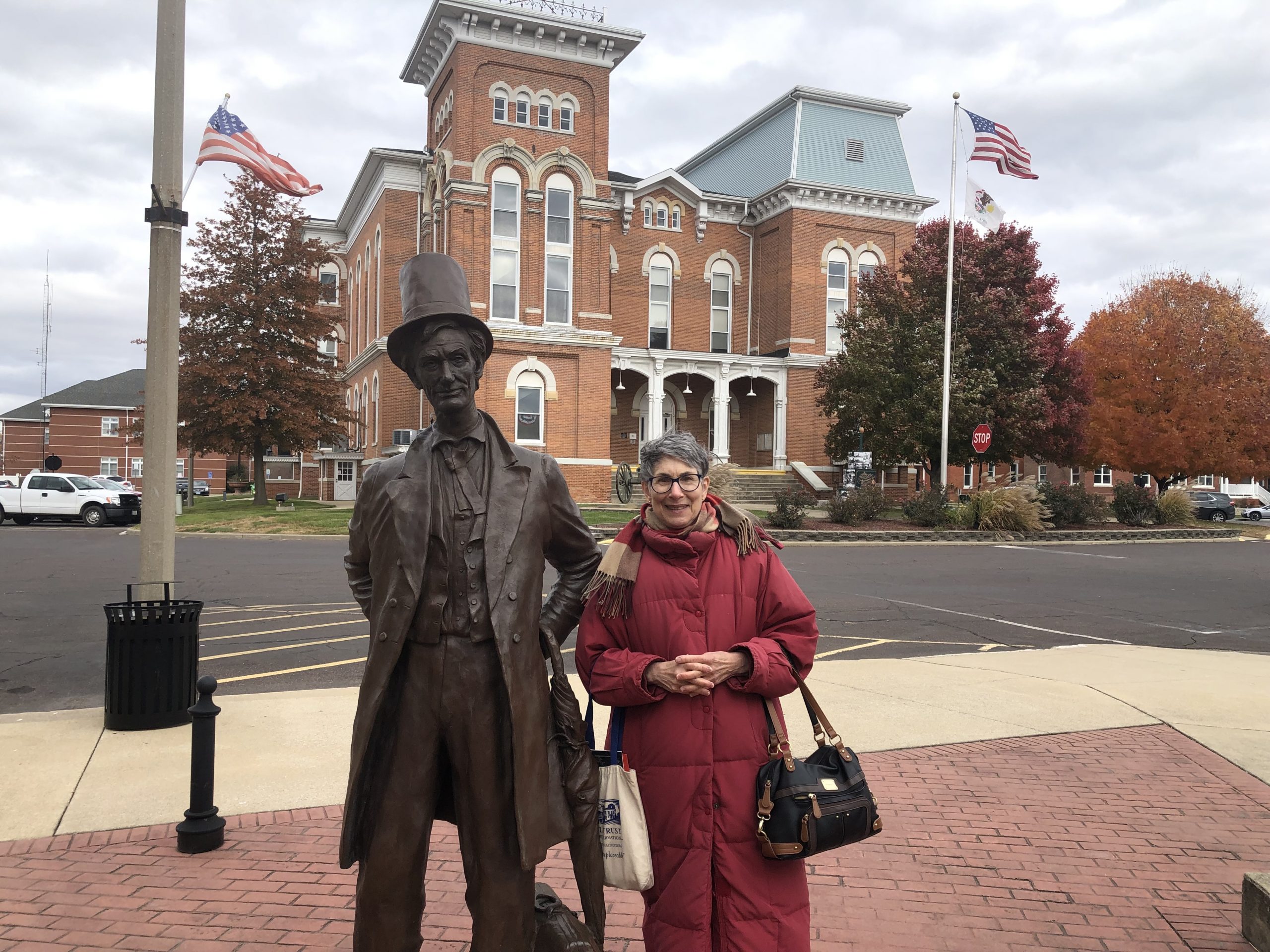
Professor Helaine Silverman beginning research in HIllsboro, November 2021. The slightly larger than life-size statue of Abraham Lincoln, appropriately placed near the Courthouse, was unveiled in 2009. Its sculptor, John McClarey, described it as portraying Lincoln, having arrived in town and stretching his sore back. Note the satchel alongside his left leg.

Jeff Dunn has been a driving force in Hillsboro’s rebirth.
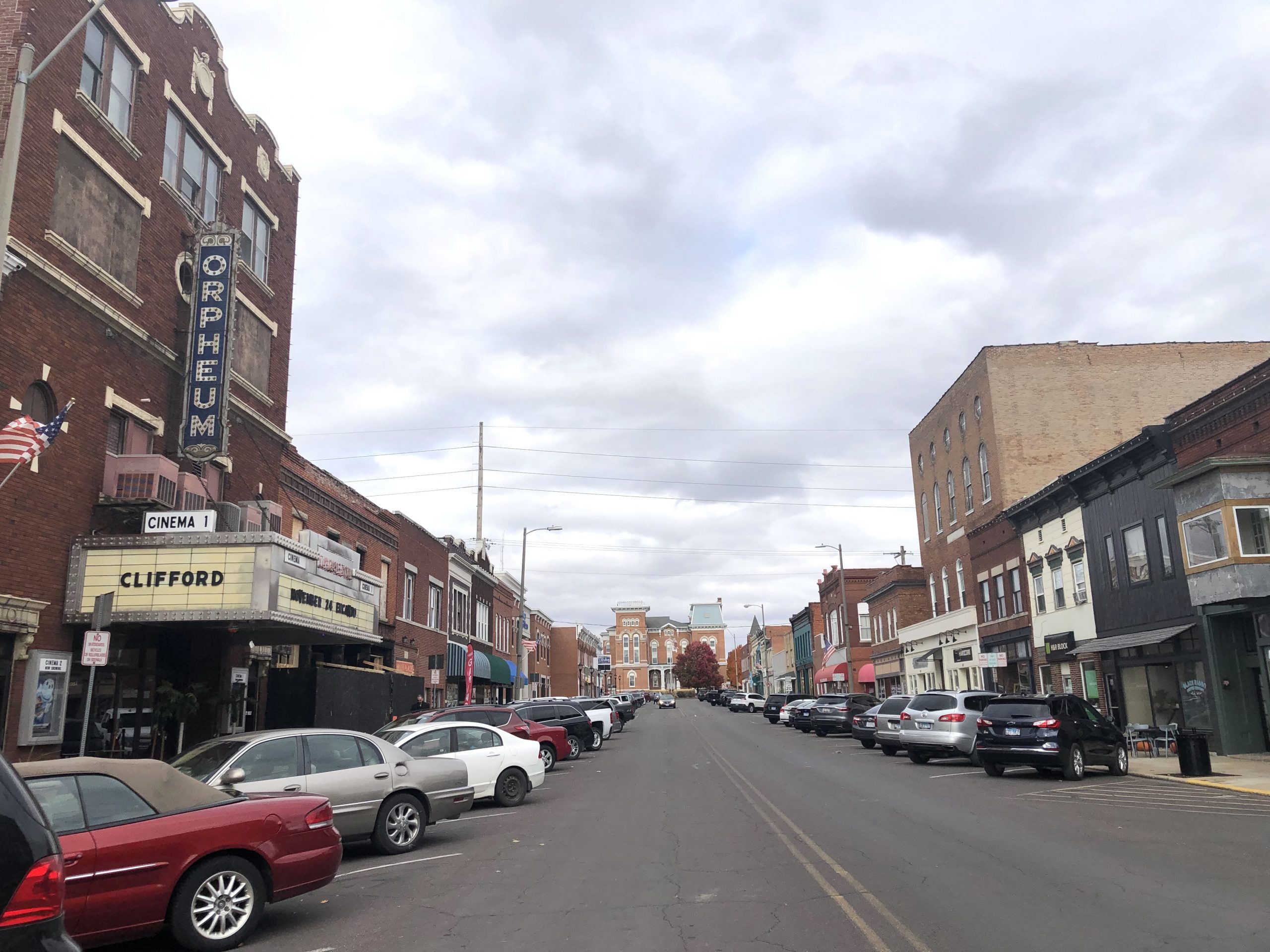
Several years ago Hillsboro business people undertook to revive their still architecturally attractive long main street, South Main Street, between Courthouse Square and the old Opera House (now the flourishing Opera House Brewing Co.) with several new shops including the wildly popular The Sweet Spot candy store and a gift shop on the opposite side of the street. One block east is a beautifully restored church that now functions as an excellent restaurant and entertainment venue appropriately called The Abbey.

Importantly, the beautiful inn that opened in 1902 as the Hillsboro Hotel (one can still see the letters HH carved on the anchor post of the lobby staircase) has been completely renovated thanks to the return of John and Kendra Wright to Central Illinois in 2013. As they tell the story, they could already see the beginning of Hillsboro’s new era and in 2017 they committed to being part of the revitalization of the community, helping a visionary group of townspeople who were remaking South Main Street. In 2018, the Wrights started a multi-million dollar restoration of the hotel, which in 1956 had been renamed Red Rooster Inn. Their historic preservation and economic development project includes fine tourist lodging and upscale apartment rentals as well as a brewery, distillery and tap room. (It should be noted that a similar process was taking place in Havana with similar success and just as we link Hillsboro to the Coal Triangle, Havana is a key element of the Great Western Illinois Experience — moreover, Havana, too, was chosen as a Spark of Innovation! city by the Smithsonian).


In 2023, the Smithsonian Institution recognized Hillsboro’s historically significant contributions to industrial innovation and its contemporary innovative revitalization by including the city in its Spark! program.
On August 2, 2025 an official historical marker is being unveiled on the Courthouse grounds, funded by the Mythic Mississippi Project and co-sponsored with the Hillsboro Old Settlers Association, the villages of Schram City and Taylor Springs, the Montgomery County Board, and the Illinois State Historical Society.