Jacksonville was a tremendously important city in Illinois in the nineteenth century. It was founded by settlers from New England. They were Yankees and arrived on the prairie in the 1800s to farm and create a vibrant community with roads, stores, taverns, an elected government, schools (including Illinois College, 1829) created by Congregational students from Yale and a Presbyterian minister) and a fervent abolitionist attitude that was supported in the various denominations of the churches they established. A courthouse we built on the town square. By 1834, Jacksonville had the largest population of any city in the state of Illinois. Chicago had only been founded in 1833 and Jacksonville dwarfed it.
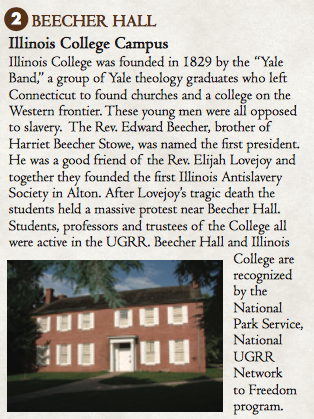
The first president of Illinois College was Edward Beecher whose sister, Harriet Beecher Stowe, wrote the influential anti-slavery novel, Uncle Tom’s Cabin. Edward Beecher shared her principles as did many in Jacksonville. Beecher Hall, dating the college founding, is still in use.
Stephen A. Douglas settled in Jacksonville in 1833, after leaving Winchester. Jacksonville is where Douglas made his name in politics, rising in Illinois and being elected to the U.S. House of Representatives in 1842. It is important to recognize that not all residents of Jacksonville shared the anti-slavery opinions expressed in Jacksonville. Douglas most certainly did not.
Abraham Lincoln conducted legal business in Jacksonville. On September 6, 1856 Lincoln delivered a passionate, two-hour long anti-slavery speech in Jacksonville, which is commemorated by a mural painted on the side of the building on the SW corner of the town square.
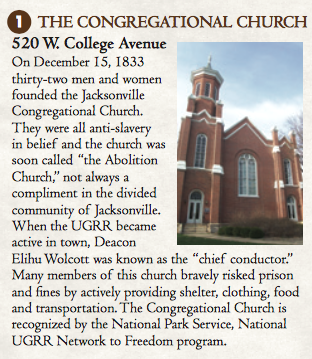
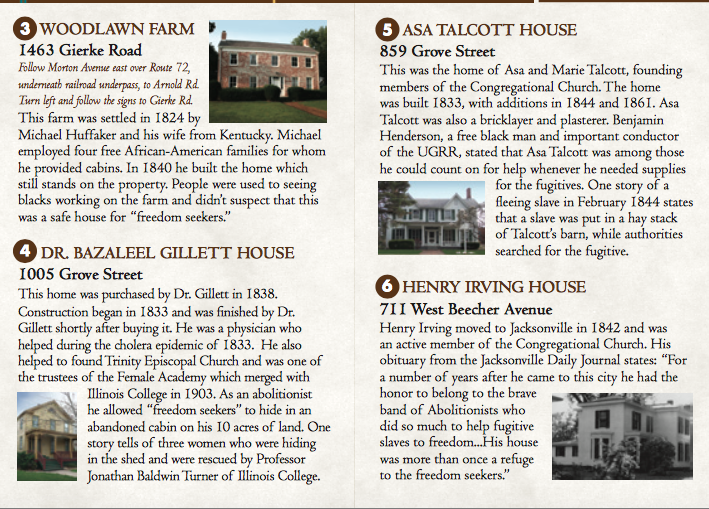
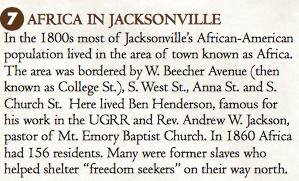
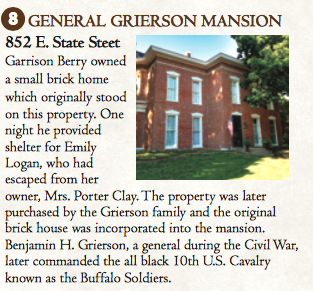
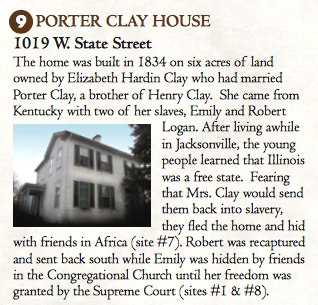
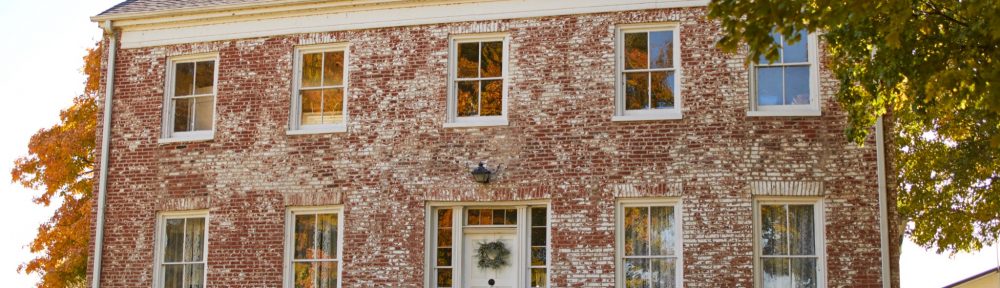
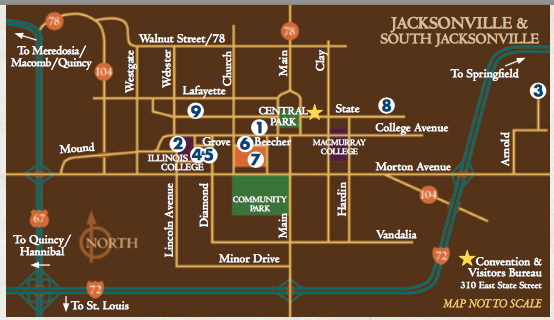
The Jacksonville Area Convention and Visitors Bureau has produced an excellent brochure (below) featuring the city’s important connection to the Underground Railroad. 
Abolitionists Jonathan Turner and Edward Beecher (brother of Harriet Beecher Stowe who wrote Uncle Tom’s Cabin, pub. 1852) were active here. As the first president (1830-1844) of Illinois College, Edward Beecher made the school a cauldron of abolitionist ideas. Former slave Benjamin Henderson arrived in Jacksonville in 1841 and also began working with the Underground Railroad.
There are at least 9 documented sites in Jacksonville that are associated with the
Underground Railroad.